Combi vs system boiler: which suits your home?
How each type works
A combi takes cold water from the mains and heats it as it flows through a second heat exchanger inside the boiler. The same boiler runs the radiators, but only one job at a time: Vaillant explains that when someone turns on a hot tap, a valve inside the boiler sends the heat to the tap, and the radiators wait until it's turned off.
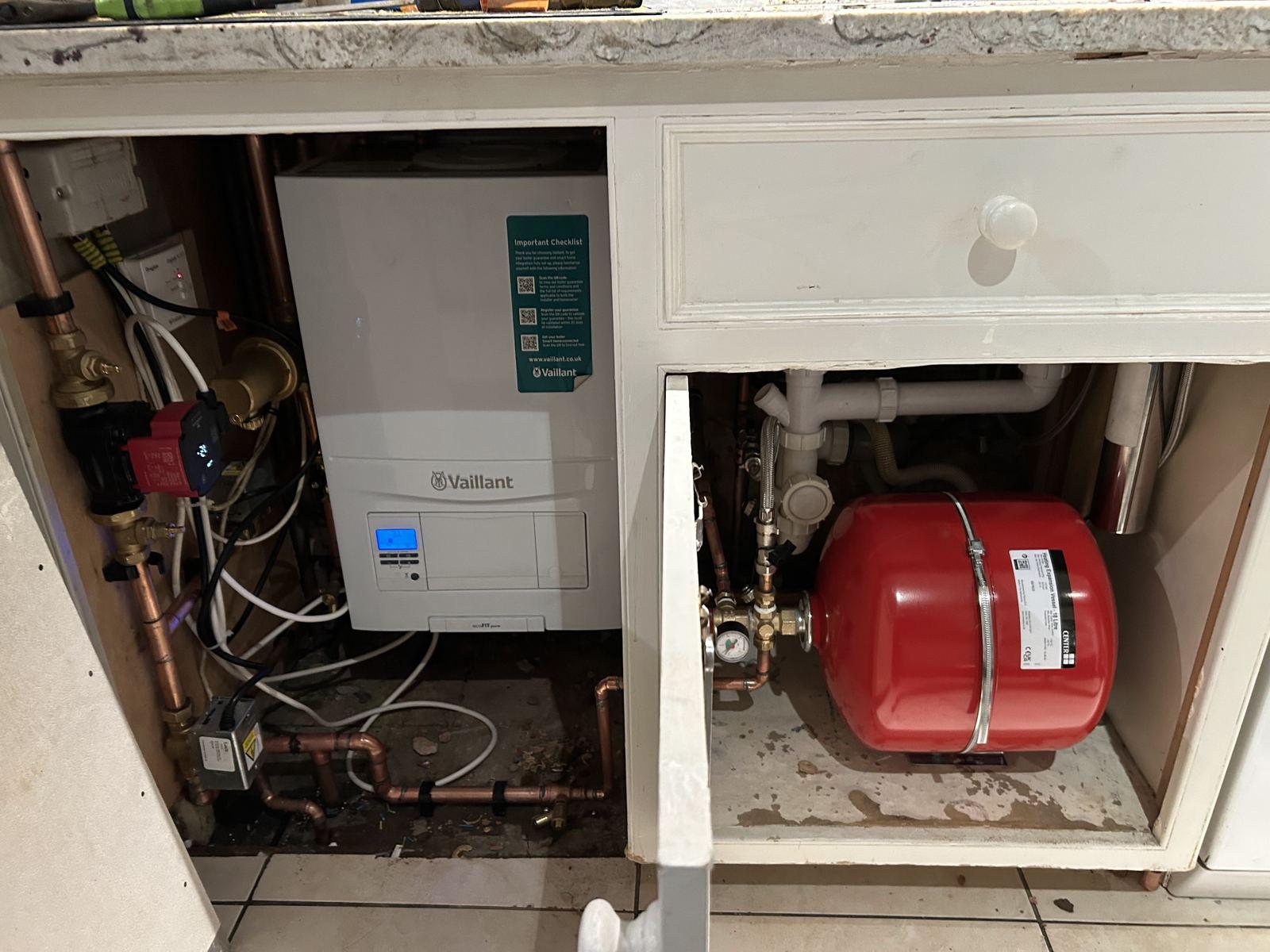
A system boiler heats the water in a sealed, pressurised heating circuit that's topped up from the mains. That water runs round the radiators and through a coil inside a hot water cylinder, heating the water stored there. The expansion vessel is often built into the boiler, and it can usually heat the radiators and the cylinder at the same time.
With a system boiler, the type of cylinder matters as much as the boiler. An unvented cylinder is fed from the mains and gives hot water at mains pressure. A vented cylinder is fed by gravity from a cold water tank in the loft, so its pressure depends on how far above the taps that tank sits.
Hot water: how much, how fast, and two showers at once
A combi's hot water is limited by how quickly it can heat the water passing through. Vaillant's figures for its ecoFIT pure combis, at a 35°C temperature rise, are 10.4 litres a minute for the 825, 12.2 for the 830 and 14.1 for the 835. Run a shower and the kitchen tap together and they share that flow, which is why Vaillant says only one outlet can be used effectively at a time on an average combi.
Heating water that fast takes power. Vaillant's data for the ecoFIT pure 835 gives up to 35 kW for hot water but 25 kW for heating, and more power means more gas, so a new combi sometimes needs a bigger gas pipe. On a Vaillant installation in West Hampstead we ran a new 28mm supply for exactly that reason.
A system boiler's limit is the size of its cylinder. Vaillant suggests sizing it at around 50 litres of stored hot water per person; when a busy morning has used it up, expect a wait of 30 to 40 minutes while the boiler reheats it. In return, several showers can run at once, and the boiler can be smaller: Vaillant's sizing guide puts a system boiler for a three or four bedroom home at 18 to 26 kW, against 28 to 34 kW for a combi.
Efficiency cuts both ways. The Energy Saving Trust says a combi's on-demand hot water makes it the more efficient choice for smaller households, while a system boiler is more efficient at producing hot water but loses some heat from the cylinder over time.
Water pressure: check yours before you choose
A combi can only deliver what the mains gives it. Vaillant points out that you can't fit a pump to boost a combi's supply. For its ecoFIT pure combis, Vaillant recommends a mains water pressure of 2 bar at the boiler, and the Energy Saving Trust gives low water pressure as one of two reasons a combi may be less suitable (the other is several bathrooms in use at once).
Two quick checks from the Consumer Council for Water: a standard bath should fill in about five minutes, and a shower shouldn't drop to a dribble when someone flushes the toilet. If yours fails either, tell us when you call, because it changes what we'd recommend.
An unvented cylinder runs at mains pressure too, so a weak supply affects it as well. Where the mains is poor, a vented cylinder fed from a loft tank, with a pump for the shower, can be the better answer. A power shower needs a cylinder to draw from, which is why Vaillant says it works with system and regular boilers but not with a combi.
Space: what each set-up needs
- Combi: just the boiler. Vaillant's ecoFIT pure is 702 mm tall, 390 mm wide and 295 mm deep, small enough for a kitchen cupboard.
- System: the boiler plus a cylinder, usually in an airing cupboard. An unvented cylinder also needs a route for its safety discharge pipe, which the Building Regulations say must be visible and must not put anyone in danger.
- Regular: the boiler, a cylinder and two tanks in the loft, one for cold water and a smaller feed and expansion tank for the heating.
In a flat, that usually settles it. The Energy Saving Trust says a regular boiler is unlikely to suit a flat, because the tanks have to sit higher than the highest hot tap or radiator.
Regular boilers, briefly
A regular boiler, also called heat-only, conventional or open vent, works like a system boiler but takes its pressure from the loft tanks instead of a sealed circuit, with the pump and valves fitted outside the boiler. The Energy Saving Trust says regular boilers tend to suit larger homes and homes with low water pressure. The drawbacks are the space the tanks take up and hot water pressure that can end up a lot lower than the cold.
If you have one and the house works well with it, changing type isn't compulsory when the boiler fails. A like-for-like regular boiler is often the least disruptive replacement in a big house.
Switching from one type to another
From a cylinder to a combi usually means:
- taking out the cylinder and any loft tanks, and removing or capping the old pipework
- sealing and pressurising a heating system that may have run at low pressure for decades, so old radiator valves and joints need checking first
- making sure the gas supply is big enough for a combi's hot water demand, and that the flue can go where the new boiler needs it
- cleaning the system and fitting a filter, so old sludge doesn't go straight into the new boiler
We made that switch in Regent's Park, NW1, where a cold water tank, a copper cylinder and an old non-condensing boiler made way for a Vaillant ecoFIT pure 825 combi.
Before you take a cylinder out, think about what comes next. The Energy Saving Trust points out that most heat pumps work with a hot water cylinder. Take yours out for a combi now, and moving to a heat pump later could mean putting one back.
From a combi to a cylinder goes the other way: you need room for the cylinder, and a new unvented one has to be fitted by an installer trained for unvented hot water and signed off under the Building Regulations. In a big house, a cylinder is often the right call even when the old one fails: in a Hampstead house with three bathrooms over four floors, we kept the cylinder set-up and replaced a leaking cylinder with an unvented Megaflo alongside the new boiler. Our hot water cylinder page covers the cylinder side.
Whichever way you go, fitting a gas boiler is gas work for a Gas Safe registered engineer, and the installation has to be notified to building control. Our boiler installation service sets out what every new boiler includes.
- Energy Saving Trust, "Boiler types explained"
- Vaillant UK, "What is a combi boiler?"
- Vaillant UK, "What is a system boiler?"
- Vaillant UK, "What is an open vent boiler?"
- Vaillant UK, "What is a hot water cylinder?"
- Vaillant UK, "How to fix a boiler diverter valve"
- Vaillant UK, "How to increase water pressure in a shower with a combi boiler"
- Vaillant UK, "What size boiler do I need?"
- Vaillant UK, ecoFIT pure
- Vaillant, ecoFIT pure installation and maintenance instructions (PDF, technical data)
- Consumer Council for Water, low water pressure factsheet (PDF)
- The Building Regulations 2010, Schedule 1, Part G3 (hot water systems)
More questions about combi and system boilers
Is a combi boiler a system boiler?
No. Both run on a sealed, pressurised heating circuit, which is where the confusion comes from, but a combi heats your hot water on demand inside the boiler, while a system boiler heats a separate cylinder of stored water. If the boiler heats a hot water cylinder in your airing cupboard, it isn't a combi.
What is a heat-only boiler?
Another name for a regular or conventional boiler. It heats the radiators and a hot water cylinder, with a cold water tank and a feed and expansion tank in the loft. It suits larger homes and low water pressure, but not usually flats, because the tanks have to sit above the highest tap or radiator.
Which is cheaper to run, a combi or a system boiler?
It depends on how much hot water you use. The Energy Saving Trust says a combi's on-demand hot water makes it the more efficient choice for smaller households, while a system boiler produces hot water more efficiently but loses some heat from the cylinder. Large families using lots of hot water are likely to be better off with a system boiler.
Can you have a power shower with a combi boiler?
No. A power shower pumps hot water from a cylinder, and a combi doesn't have one; Vaillant says the two are incompatible. If the shower is weak on a combi, the limit is usually the mains supply. An electric shower, which heats its own water from the cold mains, is one alternative.
Can I replace a system boiler with a combi?
Usually, if the mains supply is strong enough and the household doesn't often need two showers at once. The cylinder and any loft tanks come out, the pipework is altered and the heating is sealed and pressurised. It's a bigger job than a straight boiler swap, so ask for the timescale along with the price.
Boiler still not right?
Call or WhatsApp for the quickest answer. Or leave your details and we’ll ring you back.