Boiler losing pressure? How to repressurise it safely
What pressure should a boiler be?
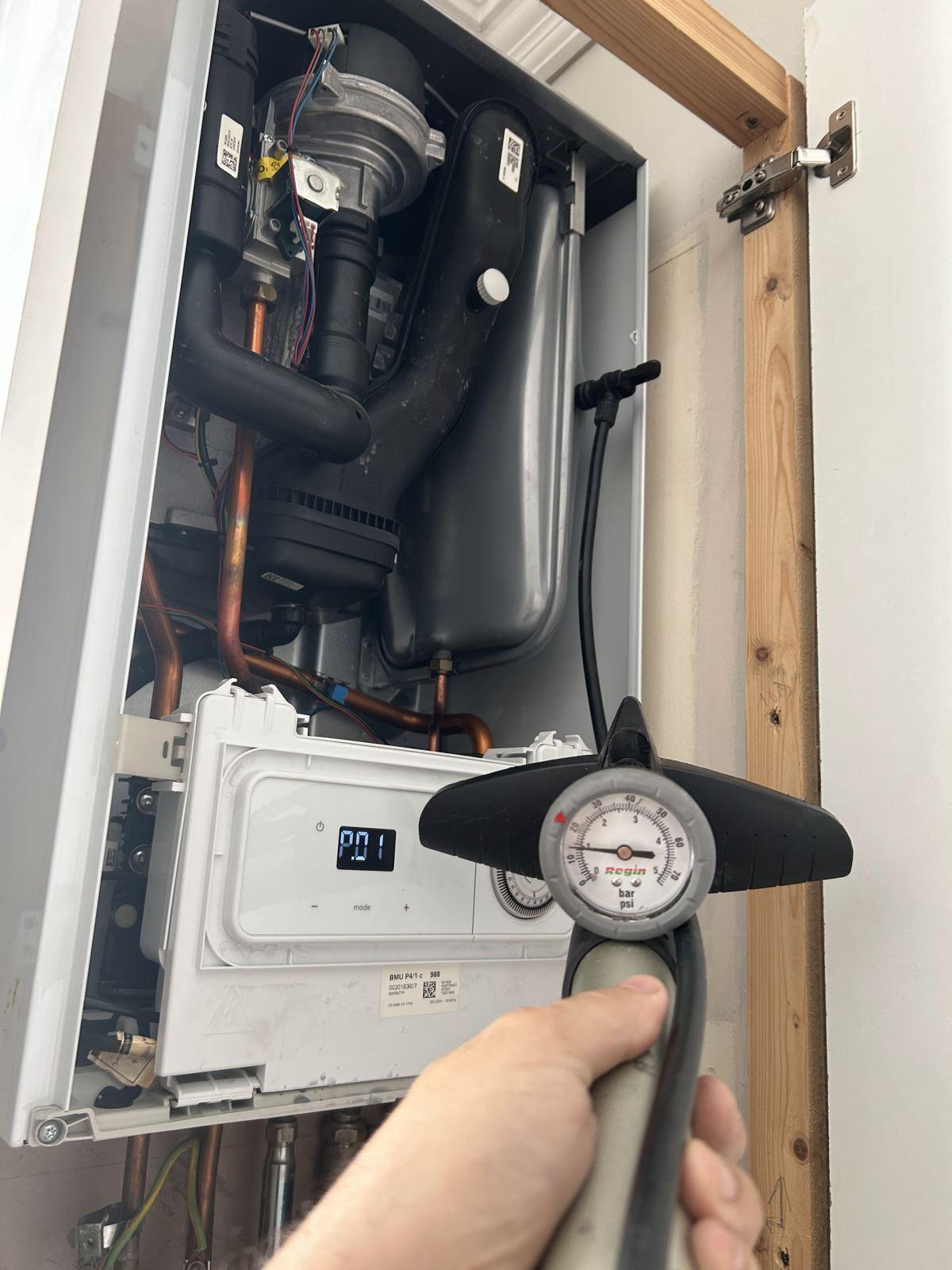
Look at the gauge on the front or underneath the boiler. It might be a dial with a needle or a number on a screen. With the heating off and the system cold, it should read about 1 to 1.5 bar. That's the level Vaillant recommends for most of its boilers, and most other makes are similar; your boiler's manual gives the exact figure.
The reading rises when the heating is on, because hot water expands. That's normal. Vaillant advises keeping it below 2.5 bar; if it goes higher, bleeding a radiator lets a little water out and brings it back down.
On a Vaillant, very low pressure usually shows on the screen as fault code F.22, and the boiler stops firing to protect itself until the pressure is topped up.
Why boilers lose pressure
A heating system is sealed, so pressure only drops when water gets out. The usual reasons:
- Bleeding radiators. Letting air out also lets a little water out. Bleed a few radiators and the pressure drops, which is why you often need to top up afterwards.
- A small leak. A weeping radiator valve, a pipe joint under the floor or a leak inside the boiler. Check under the radiators and around the pipes below the boiler for drips or damp marks.
- The pressure relief valve letting water out. This valve opens when the pressure gets too high and drains through a small pipe, usually to an outside wall. If that pipe drips, the valve may be faulty or the pressure is running too high.
- A tired expansion vessel. The vessel inside the boiler absorbs the water's expansion when it heats up. When it loses its charge, the pressure shoots up when the heating is on, the relief valve opens, and the pressure is low again when the system cools.
How to repressurise a boiler with a filling loop
Check your boiler's manual first: every model is slightly different. As a general guide, this is the method Vaillant gives:
- Turn the boiler off and let the system cool. A cold system gives an accurate reading.
- Find the filling loop. It's usually a silver braided hose under the boiler, joining the mains water pipe to the heating pipe, with a valve at each end. Make sure it's firmly connected at both ends.
- Open the valves slowly. Turn the isolation valve (often with a flat-head screwdriver) until its slot lines up with the pipe, then open the handle valve. You'll hear water running in.
- Watch the gauge. Stop when it reaches 1 to 1.5 bar, or the level in your manual. Don't rush: it's easy to overfill.
- Close both valves. Handle valve first, then the isolation valve. If your filling loop is the detachable type, remove it.
- Switch the boiler back on. Press reset if it's showing a fault code, and check the pressure has stayed where you left it.
Some boilers, often older combis, have a filling key or a lever under the boiler instead of a hose. The idea is the same: turn off, open the filling valve until the gauge reaches the right level, close it firmly, and switch back on. Your manual shows where it is.
When to stop and call an engineer
Topping up the water is fine for a homeowner. Call a Gas Safe registered engineer if:
- the pressure drops again as soon as you close the valves, which points to a significant leak or a faulty pressure relief valve (Vaillant's advice is not to keep repressurising)
- the pressure dropped suddenly rather than slowly
- you're having to top it up again and again
- there's water inside or underneath the boiler, or the pipe through the outside wall keeps dripping
- the pressure climbs above 2.5 bar every time the heating comes on
Never take the boiler's casing off. Everything inside the case is gas work, and in the UK only a Gas Safe registered engineer can touch it.
We find and fix pressure faults as part of our boiler repair service. A repair visit is £120, including up to one hour on site, £60 comes off it if you go ahead with a quoted repair, and evening visits between 5pm and 10:30pm are £159 on the same terms.
More questions about boiler pressure
Is it safe to repressurise my own boiler?
Yes. Topping up the water with the filling loop or filling key is a normal homeowner job and doesn't involve any gas work. Turn the boiler off first, follow your manual, and never take the casing off.
Why does my boiler pressure go up when the heating is on?
Water expands as it heats, so the pressure rises a little when the heating runs. That's normal. If it climbs above about 2.5 bar, or the relief valve pipe starts dripping, the expansion vessel may need re-charging by an engineer.
How often should a boiler need topping up?
Rarely. A sealed heating system shouldn't lose water. If you're topping it up regularly, there's a leak or a faulty part somewhere, and it's worth having it found before it does damage.
What does F.22 mean on a Vaillant boiler?
F.22 usually means the water pressure is too low for the boiler to fire. Top the pressure up to 1 to 1.5 bar with the filling loop, then press reset. If the code keeps coming back, the system is losing water and needs an engineer.
Boiler still not right?
Call or WhatsApp for the quickest answer. Or leave your details and we’ll ring you back.